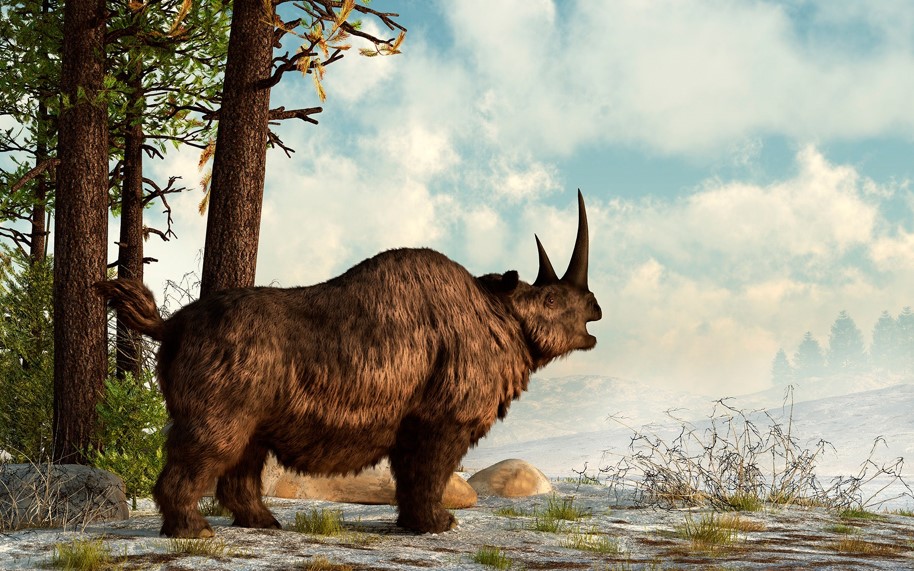
by Russ Hedley of Nature Talks & Walks, who came to talk to us in February 2024.
When exploring the British countryside there are hundreds of species to enjoy. There are however some noticeable gaps in the big picture, literally. Animals that have recently and not-so recently been exterminated, out-competed or lost to time in some other way, still make their presence felt today. British nature is adapted to cope with the pressure of large lumbering herbivores. 
Think about why bushes can be severely bent over, just to grow into a thick and healthy hedge. Handy adaptation when being trampled by the straight-tusked elephant. Or the now rare species of insect such as the Southern Damselfly, so specific in their requirement of watery habitat. The presence of beaver across the country would have created a myriad of micro-habitats for such bugs to thrive, in turn created food for aerial predators.
Think about why bushes can be severely bent over, just to grow into a thick and healthy hedge. Handy adaptation when being trampled by the straight-tusked elephant. Or the now rare species of insect such as the Southern Damselfly, so specific in their requirement of watery habitat. The presence of beaver across the country would have created a myriad of micro-habitats for such bugs to thrive, in turn created food for aerial predators.
But to have just these herbivores does not biodiversity beget. Left uncontrolled elephant, rhino, beaver, wild horse and auroch (extinct cattle), would overgraze and over churn the soils of their habitat. Having their predators such as lynx, wolf, bear and the elephant-hunting scimitar-toothed cat, would keep herbivores on their toes and keep them on the move. This means they’d never over graze one site. Many botanists will agree that this is a problem we face today in Britain with our deer population, which could be brought to a quarter of today’s number, still be healthy and produce more flowers in the wild, healthy hedges for nesting birds and even create healthier deer. When not hunted, ill deer survive for longer, spreading disease among their kind. Predators such as the lynx, which focuses greatly on deer for food, could help the deer population.
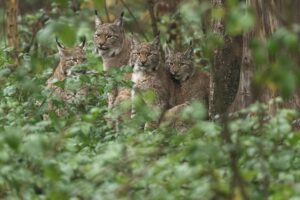
But in order for reintroduction we must do our homework first. Lynx need connected forest to move and find what they need – food, water, shelter and mates. in 2015, Britain had an estimated 10% tree cover placing it 37th in Europe of most forested countries. Things improved in 2018 as Forestry Research recorded 13% forest cover. Replenishing enough forest gives room for lynx and always the benefit of their presence to be felt.
Using a bulldozer at cost to create a scrape for wading birds? Britain once had rhino and hippo doing just that until relatively recently. In fact most animals of the african plains could be found here, including hyena and lion. And in all cases, our versions were the biggest of their kind on the planet. Rochdale would have looked very different over 10,000 years ago. It is good to remember these incredible animals, their role in our ecology and how by replacing them, we now do their work to ensure as diverse a Britain as we can.
To find out more about ice age megafauna, check out: